The Organizational Psychology Answers Lab (OPAL) at Central Connecticut State University
builds tools that help students say what they can do, and studies whether those tools work.
Framework and tools
CR Path: the Career Readiness Pathway
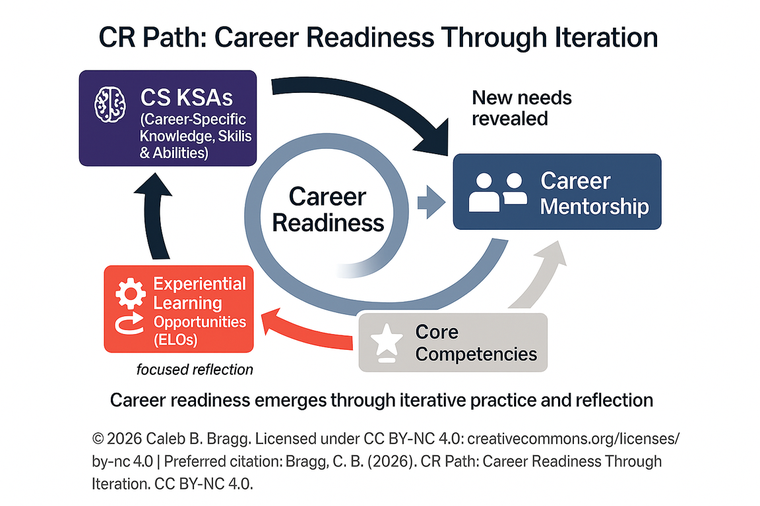
A framework, published with James M. Conway, that describes career readiness as four
components developed through iteration rather than in sequence:
- Career-specific knowledge, skills, and abilities
- Core competencies
- Experiential learning opportunities
- Career mentorship
Module 0 is the interactive entry point. Students work through reflective prompts,
rename the framework in their own words, and leave with an articulation they can use in
advising, interviews, and course planning. In fall 2026 it runs in courses across
fourteen instructors and in Central Career Launch, the university's student
employment program, whose supervisors I trained to use it in August 2026.
Funded pilot
SCALE: Scientific Communication + AI Literacy Experience
A pilot funded by a Connecticut Tech Talent Accelerator 3.0 Innovation Grant, running
September 2026 through August 2027. It teaches students to evaluate evidence across
the natural, social, and behavioral sciences, test AI output against primary sources, and explain what they find to the
people who make decisions.
- Translational Literacy in Science, a 3-credit course, spring 2027
- Co-taught by a natural scientist, a social scientist, and an AI librarian
- Fifteen discipline modules being written by CCSU faculty, to be released CC BY-NC 4.0
- Paid summer micro-internships with Connecticut organizations
Lead partners are the New Britain Public Library and CT Humanities, with placements
administered by CCSU's Central Workforce and Innovation Hub. The course is the first
piece of a proposed Certificate in Applied Scientific Communication. SCALE is built on
the Translational Literacy Framework.
Immersive learning
XR Meditation Skill Transfer study
A program of research in the CCSU XR Lab, begun in 2025, on whether a short guided
meditation between two AI-powered mock interviews improves performance. In the first
study, students' interview scores rose, state anxiety fell, and attitudes toward VR
and AI grew more positive, with VR and in-person meditation producing similar results.
Three undergraduate co-authors presented the first results with me at the Eastern
Psychological Association's 2026 meeting.
The current study validates a VR meditation we built at CCSU in Uptale, a no-code
platform that turns 360° video into VR. A psychology research assistant filmed the
video at locations across Connecticut, recorded the box-breathing meditation, and
helped assemble it. In spring 2027, employers and community organizations will try the
protocol, with an interview built around their own scenario, and say whether it belongs in
hiring, training, onboarding, and job-readiness programs. Funded by a 2026–2027 CSU-AAUP Faculty
Research Grant, in partnership with the XR Lab and the Central Workforce and
Innovation Hub.
Faculty development and partnerships
Taking the framework beyond one department
In July 2026 I ran two campus workshops that prepared faculty and staff from a dozen
disciplines to use Module 0 in their own courses. In
April 2026 I gave the keynote on the framework at the Connecticut Department of
Labor's Learns and Works symposium.
Whitepaper
Knowledge: the real durable skill
Employers say they want durable skills such as communication and critical thinking.
I argue those are knowledge in use, and show how the measurement tradition
that could see knowledge was abandoned. It closes with practical moves for employers
and educators.